







Gabion Baskets
HERMEQ supplies gabion baskets made from square mesh, welded at every intersection so that each basket holds its shape when it is filled, in a choice of wire diameters. Welded mesh gabions build free standing walls, cladding and other landscape structures in agricultural and commercial settings, and they are used for retaining walls, river control and erosion defence. The range also includes gabion rock rolls for erosion control along riverbanks and wetland edges.
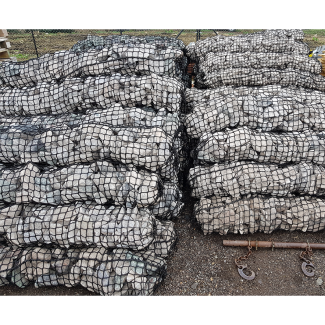
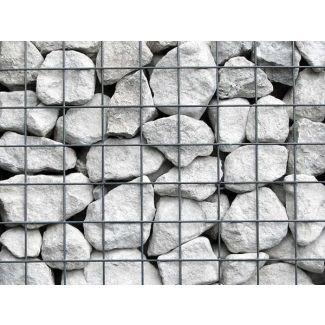
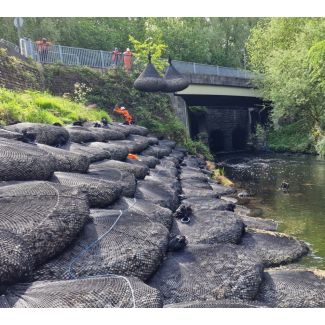
Welded mesh gabion baskets and rock rolls
The two types suit different shapes of work: a box gabion builds a face that stands up, and a rock roll lies along the ground at the water's edge.
Welded mesh gabions
These are box baskets that are stood up on a prepared base, joined to the units beside them and filled in place, so that a run of them becomes a wall with a vertical or stepped face. Choose welded mesh gabions for retaining walls, free standing walls, cladding and any structure where the stone has to stand in a defined shape.
Gabion rock rolls
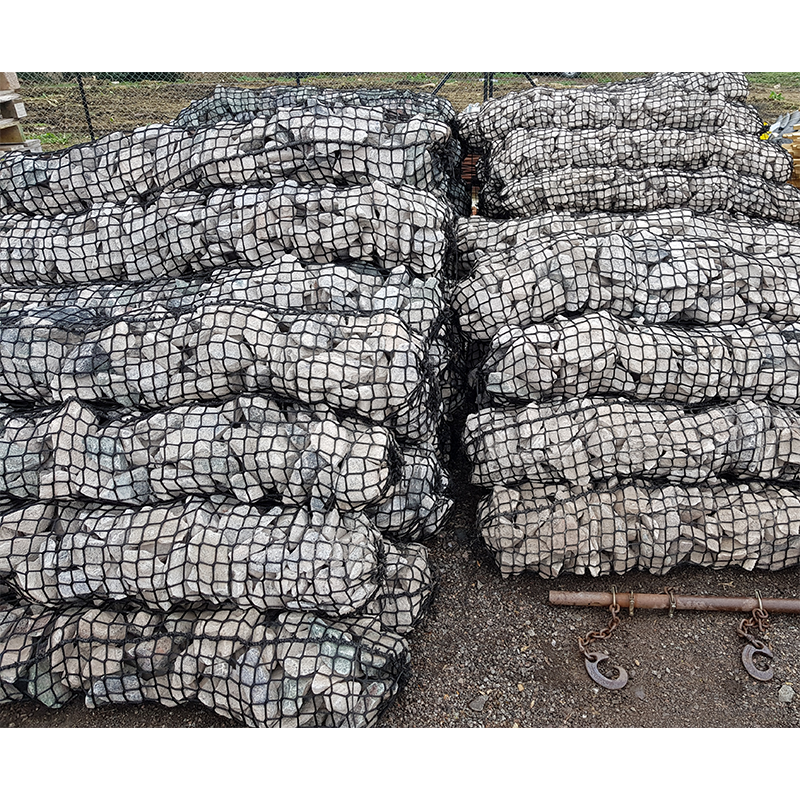
Rock rolls are permanent, flexible rolls of stone laid along the toe of a bank in wetlands, rivers and pond margins, where they stop washout and scour at the waterline. Choose gabion rock rolls where the job is protecting a soft, wet bank edge and no vertical face is needed, because the roll follows the line and level of the bank. They also form a foundation for coir logs, coir pallets and sods, and as the planting establishes, its roots grow into the voids between the stones and hold the bank for the long term.
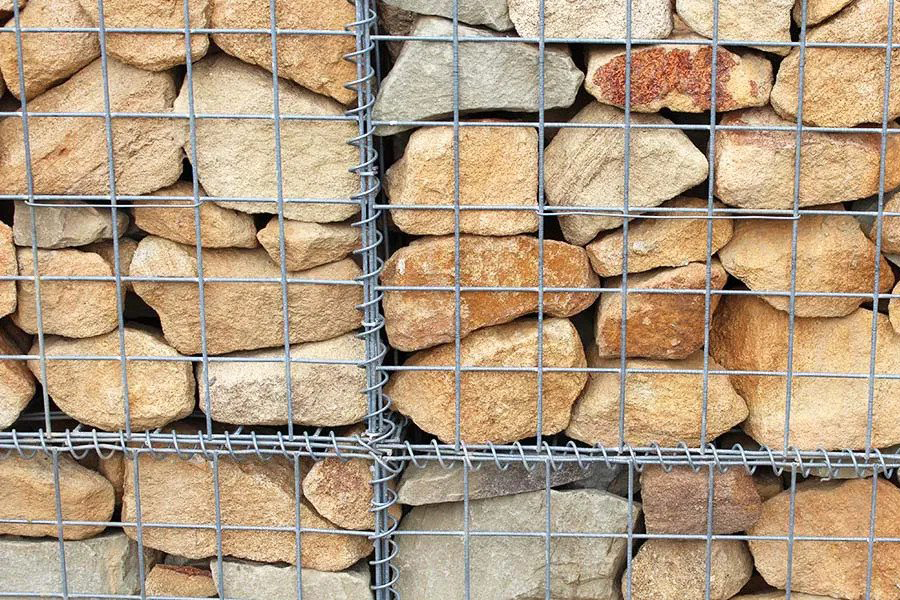
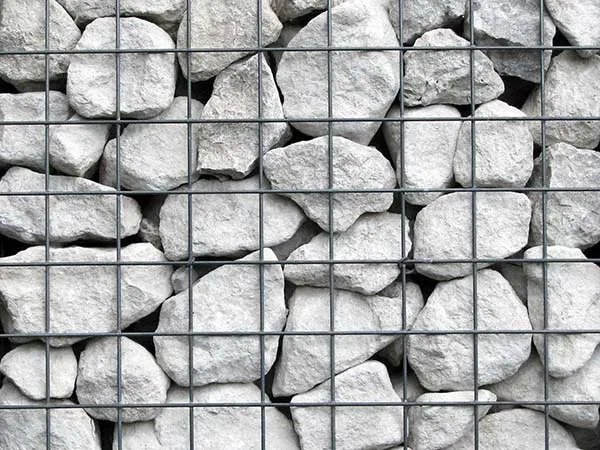
Gabion cage sizes and wire diameters
Wire diameter
The welded range runs from 3mm to 5mm wire. The lighter wire suits landscaping, cladding and low free standing walls, where each basket mainly holds its own fill and the appearance of the face comes first. The heavier wire suits retaining walls that hold back soil, and baskets that face flowing water, where the mesh takes the force of the current and the abrasion of stones and debris carried in a flood.
Basket height
Baskets come in half height and full height units. Full height baskets build the main courses of a wall, with fewer layers to set out, join and fill. Half height baskets bring a wall to its finished level where another full course would overshoot it, and they form steps, copings and plinths, or the low first course of a stepped landscape wall.
Basket length
Single and double length units are available. Longer units mean fewer joins along a long run, which saves time on site and gives a straighter face, while single length units are easier to place at corners and returns and on short walls and pillars.
Gabion stone and fill
Gabion baskets are filled with rock, quarried stone or crushed concrete, chosen for hardness and for the finish the face needs. Every piece of fill must be larger than the mesh opening, or smaller stones will work their way out through the face as the wall settles. On walls that will be seen, the face stones are often placed by hand, flat side outward and packed tightly, while the core behind them is filled more loosely by machine. For river and reservoir work, hard, frost resistant rock holds up better than stone that softens or splits when it is wet, and crushed concrete is better suited to landscape and retaining walls in dry ground.
Gabion walls, erosion control and landscaping
Retaining walls
A gabion retaining wall holds back soil by its own weight, so each course is usually set back into the slope from the one below it, which leans the wall into the ground it retains and gives a stepped face. The backfill behind the wall is placed and compacted in layers as each course goes up, so that the soil and the baskets settle together.
River control, erosion defence and reservoirs
Along rivers, streams, channels and reservoir margins, the baskets that matter most sit at the toe of the bank, where flowing water undercuts the slope first. They are built from below the level the current can scour, so that it cannot get beneath the bottom course. Where a flexible scour layer suits the bank better than a basket, Aqua Rock Bags are rock-filled nets laid at the toe for scour protection. Plant and materials reach the bank across bog mats laid over the softest ground. On firmer access routes, ground protection mats carry the traffic.
Free standing walls, cladding and landscaping
In agricultural and commercial landscaping, gabions build free standing walls and boundary walls, and they clad block or concrete walls in stone. A free standing wall has no slope to lean on, so its height in relation to its width matters more than on a retaining wall, and taller runs are often built two baskets wide.
Popular Categories

Road Forms
View Products >

Trench Covers & Road Plates
View Products >

Bog Mats
View Products >
Frequently Asked Questions
Yes. A gabion is a wire mesh container filled with stone, and gabion basket, gabion cage and gabion box are other names for the same unit.
Adjacent baskets are joined along every edge where they touch, usually with spiral binders, lacing wire or C rings, so that the whole run settles and moves as one structure. Lids are closed and fastened the same way once each basket is full.
Bulging happens when the fill pushes the face outward faster than the bracing and the neighbouring baskets can hold it. Fit bracing wires across each basket as you fill, bring adjacent baskets up together and pack the face stones tightly so that there are no large voids. On walls where the line matters, a timber or steel frame clamped to the face during filling keeps it straight.
A gabion wall needs a firm, level base, with topsoil and soft material dug out and the formation compacted, because the baskets settle with whatever is below them. On weaker ground, a layer of compacted hardcore or a concrete strip gives a consistent footing. On a slope, the base is cut into level steps so that every basket sits flat, and a geotextile under the bottom course stops fine soil working up into the fill.
A low landscape wall is often built to standard practice, but a wall that retains a road, a building, a car park or a deep cut is designed by an engineer. The design sets the base width, the number of courses, the step back and the wire diameter. Gabions in rivers and reservoirs are designed in the same way, because scour and flood flows decide how the structure is built.
Gabions are free draining, so water passes through the stone and does not build up pressure behind the wall as it does behind a solid wall. A geotextile between the retained soil and the back of the baskets stops fine material washing into the fill and clogging it.
A full height single basket, at 975mm each way, holds just under one cubic metre of stone, and a half height basket a little under half that. Order the stone from the total volume of baskets in the wall, and the quarry converts that volume to tonnes for the stone it supplies.