







Geocomposite Drainage
Geocomposite drainage collects water from the surrounding ground and carries it along a plastic core to an outlet. It is used on road embankments, in tunnels, in engineered landfills and around residential foundations.
The geocomposite drainage net is the thin format. It has an extruded HDPE net core with a non-woven polypropylene geotextile bonded to both faces, and that filter keeps soil out of the core. Techdrain is the cuspated HDPE board, with a deeper core and higher flow. Techdrain Fin25 is a fully wrapped strip for fin drains and the passive venting of gases and liquids.


Drainage geocomposite types: nets, boards and fin drains
The three formats differ in the depth and shape of the core and in where they are laid, so the job usually points to one of them before any grade is chosen.
Geocomposite drainage net
The geocomposite drainage net is also known in the trade as a geonet composite or simply a drainage net. It is the format for general area drainage under fill, beneath landscaped and sports surfaces, and behind walls where only a thin layer will fit and soil bears on both faces. Net cores across the range run from 4.5 to 8 mm.
Techdrain cuspated drainage board
The Techdrain cuspated drainage board is the format buyers also call a sheet drain, a drainage board or a dimpled drainage board. Its moulded cusps hold open a deeper void than a net, which suits jobs with more water to carry and drains that sit directly against concrete, blockwork or a waterproofing membrane. Techdrain comes in 6, 12 and 25 grades, so one board type covers a shallow wall drain and a high flow drain behind a deep structure.
Techdrain Fin25 fin drain and ventformer
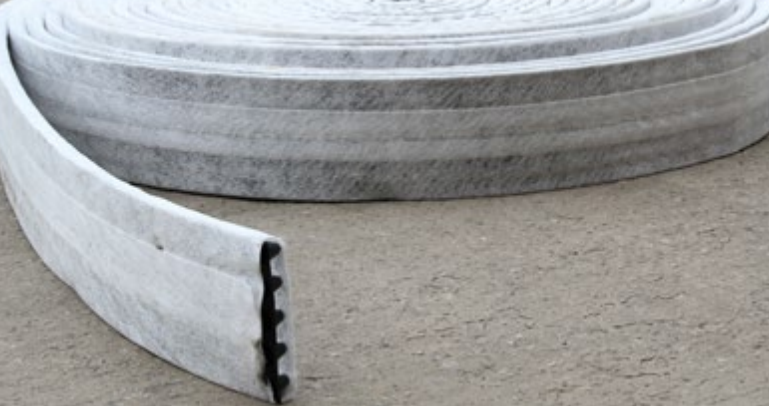
A fin drain is a narrow vertical drainage strip stood in a trench, with a carrier pipe at its base to take the water away. The Techdrain Fin25 fin drain is a cuspated strip fully wrapped in filter for that job along road edges, verges and embankments, and the same strip is used as a ventformer to give gas and water a passive path out of the ground. Strips run from 150 to 900 mm wide, and the width is chosen to match the depth of trench to be drained.

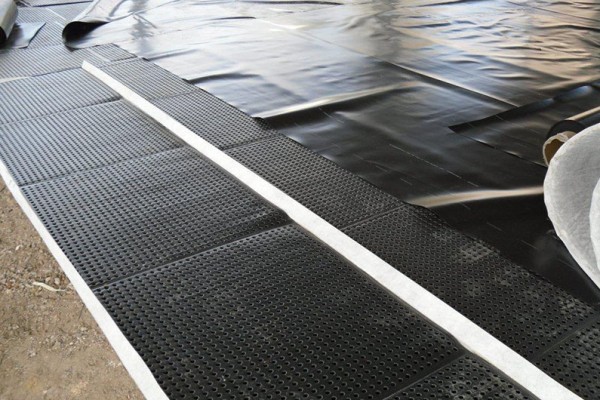
Geocomposite drainage net or cuspated drainage board
The choice between the two main formats turns on how much water the drain must carry and what lies against each face. The bonded geonet is the thin, flat option.
The cuspated Techdrain board is the deeper option. It is chosen where groundwater flows are higher, where the drain runs a long way before it reaches its outlet, or where one face sits against a structure or its waterproofing and the plastic side of the board can bear on it.
On a residential foundation with modest groundwater, either format will drain the wall, and the net's lower profile usually decides it. Behind a deep retaining wall, a tunnel lining or a podium deck with long drainage runs, the board's deeper core is the usual choice.
Geocomposite drainage layer in place of a stone layer
A geocomposite drainage layer takes the place of the stone or gravel drain that would otherwise be built behind a wall, under fill or beside a slab, together with the geotextile wrap that stone needs to stay free of fines. The rolls are light enough to hang on a vertical face and unroll across a formation, so the excavation can be narrower, fewer lorry loads of stone come to site and no granular material has to be placed and compacted against the wall as it is backfilled.
The composite does not replace the rest of the drainage system. It collects water and carries it along the core, so the base of the layer needs a collector pipe, channel or outlet to take that water away, and the top edge needs to be closed off by folding the filter over the core or tucking it under a capping, so that backfill cannot fall into the void.
Drainage boards for retaining walls, foundations, roads and landfill
Retaining walls and foundations
Behind a retaining wall, bridge abutment or foundation wall, the composite relieves water pressure by giving groundwater a free path down to a pipe at the footing. The drain runs the full height of the wall and connects at its foot to the land drain.
Road embankments and fin drains
Fin drains run along road edges, verges and the toe of embankments, where they intercept groundwater before it reaches the road foundation or softens the slope. Where the slope face also needs holding, erosion and sediment control products are laid with the drainage.
Tunnels
Behind a tunnel lining or a cut-and-cover box, the composite carries seepage around the structure to the side drains, so water does not stand against the waterproofing.
Landfill and ground gas venting
Engineered landfills use drainage composites in lining and capping layers to carry away leachate and surface water. Fin25 was designed as a passive venting system for gases and liquids, so it is the format for vent trenches and venting layers at the edge of a site or beneath a structure, where gas needs a clear path to the surface. The layout of any venting system comes from the site's ground investigation and gas risk assessment.
Drainage composite filter, thickness and orientation
Geotextile on one side or both
A filter is needed on every face that soil touches. Where the drain sits against a wall, slab or waterproofing membrane, a single filter is right: the plastic face of the core bears on the structure and the filter faces the soil, letting water in and holding fines back. Where soil lies against both faces, as in a layer within fill, a filter on both sides is needed. Techdrain is supplied with the filter on one or both sides, and the net carries a filter on each face. A single-sided board fitted the wrong way round puts bare plastic against the soil, and the core will silt up.
Core thickness within each format
Within a format, a deeper core carries more water. A thicker grade suits higher groundwater flows, drains under a deep layer of fill that presses the filter into the core, and drains laid at a flat fall where water moves slowly along them. Thinner grades suit vertical drains behind walls with modest groundwater.
Composite, geotextile or geomembrane
A drainage composite moves water along its own core. A plain non-woven geotextile filters and separates without a core, and it is the right buy for wrapping a stone drain or pipe or for separating fill from subsoil. Geomembranes are impermeable sheets that stop water and gas, used to line ponds, lagoons and landfill cells. Some jobs need a membrane and a composite together, with the drain on the soil side of the membrane.
Popular Categories

Geotextile Membranes
View Products >

Grass Pavers & Gravel Grids
View Products >

Geogrids
View Products >
Frequently Asked Questions
No. A cavity drainage membrane is a studded sheet fixed to the inside face of a basement wall or floor, where it leads water that has come through the structure to a sump as part of internal waterproofing. A drainage composite is placed outside the structure, in the ground, with a geotextile filter facing the soil, and it carries groundwater to a land drain before it reaches the wall.
Yes. Laid flat, a drainage composite drains a formation beneath fill, a podium deck, a landscaped roof or a sports surface, and it can sit beneath a slab to collect water rising from below.
Flow capacity is measured as in-plane flow: water is passed along the core while the composite is held under a set pressure at a set hydraulic gradient, and the result is reported in litres per second per metre width. The test is repeated at different pressures and gradients, so a designer can read off the flow for the depth of fill and the fall on a given job.
Adjacent rolls are butted together so the cores meet, and geotextile is lapped over the joint so soil cannot enter between them. On a wall or slope, the upper roll laps over the lower one so water runs across the joint and not into it. Laps are taped or held with the same fixings used for the drain.
A drainage board is hung from the top of the wall and held with fixings through the core near its upper edge, or with an adhesive that suits the waterproofing, so no fixings are punched through a tanking membrane below ground. Backfill then holds the board against the wall. The fill is placed and compacted in layers, with care taken that plant does not tear the filter.