







Builders Trestles
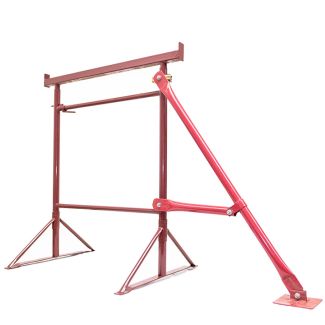
Builders trestles, also known as band stands, are adjustable steel stands that carry scaffold boards to form a working platform for construction and maintenance work. HERMEQ's trestles are made from tubular steel with a zinc-plated finish, which resists rust on site and keeps each trestle light enough to carry between rooms and floors. The height adjusts to suit the task, and each trestle takes up to four scaffold boards, enough for a deck that holds the person working on it along with their tools and materials. For work at height, the range also includes stabilisers, ladder brackets, safety posts, gates and S brackets, which build a guarded platform on the same trestles.

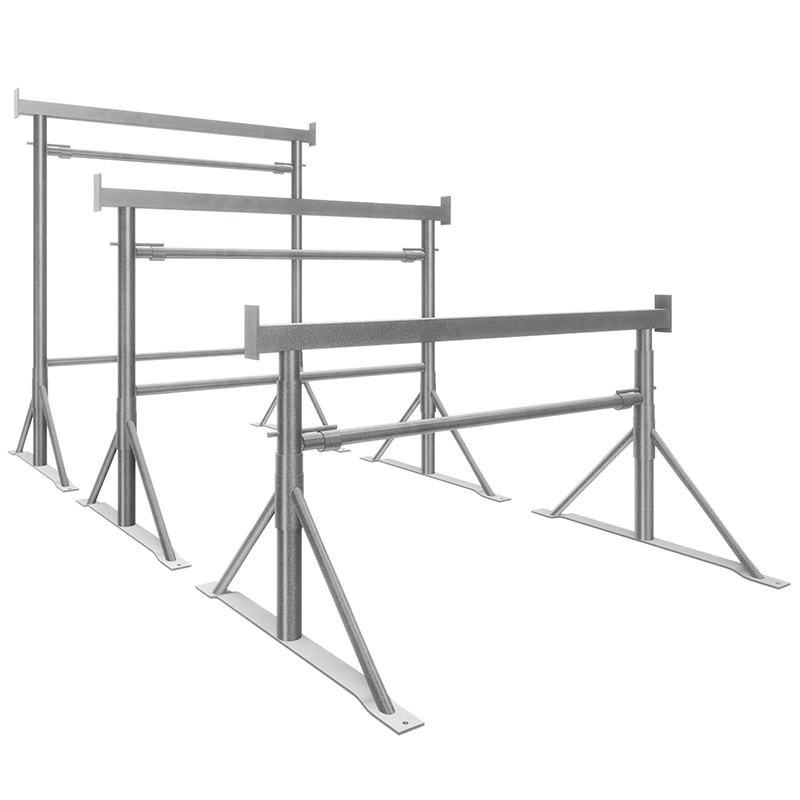
Builders trestle sizes 1, 2 and 3
Choose the size of builders trestle tables whose adjustment range covers the platform height the job needs. The numbers rise with height, from the low size 1 to the tall size 3.
Size 1 builders trestles
A size 1 trestle carries a low platform for internal work a short reach above floor level, such as ceilings in houses and apartments and the upper part of walls in rooms of standard height. It is the most compact of the three to carry up stairs and through doorways.
Size 2 builders trestles
The size 2 sits in the middle of the range and suits plastering and decorating runs under higher ceilings, in stairwells, halls, shop units and commercial interiors. It is the size to choose when one set of trestles has to cover a mix of interior jobs.
Size 3 builders trestles
The size 3 is the tallest in the range and is the trestle for brickwork lifts, external walls and taller interior work that a size 2 does not reach.

Trestles for bricklaying and plastering
Bricklaying
On brickwork the platform moves up with the wall, so the trestles are reset at each lift and the deck has to be level and fully boarded every time it is raised. A bricklaying deck carries more than the gang standing on it, because stacked bricks or blocks, mortar boards and the mortar itself all sit on the boards. Materials are spread along the run and kept off the middle of a single span, and mortar is fed to the boards from mortar tubs kept beside the run.
Plastering and ceiling work
Plastering needs one long, continuous run at a single height, so a plasterer can work across a whole ceiling or wall without stepping down to move the platform. On second fix and refurbishment work, laying floor protection under the run before setting up stops the trestle feet marking screeded, tiled or timber floors and keeps plaster and slurry off the floor.
Trestle safety posts, gates and stabilisers
An open trestle run needs edge protection once the platform is high enough for a fall to cause injury, and at any open side or end where someone could step off.
Trestle safety posts
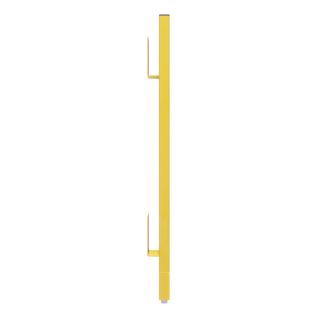
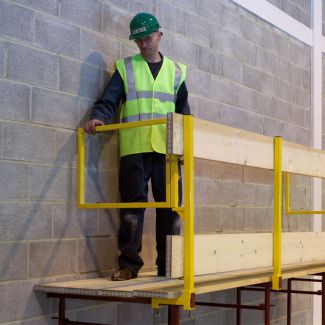
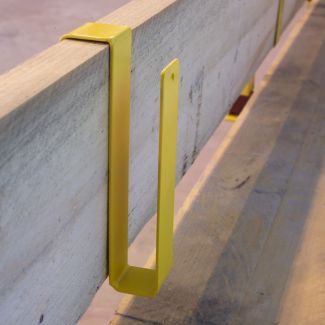
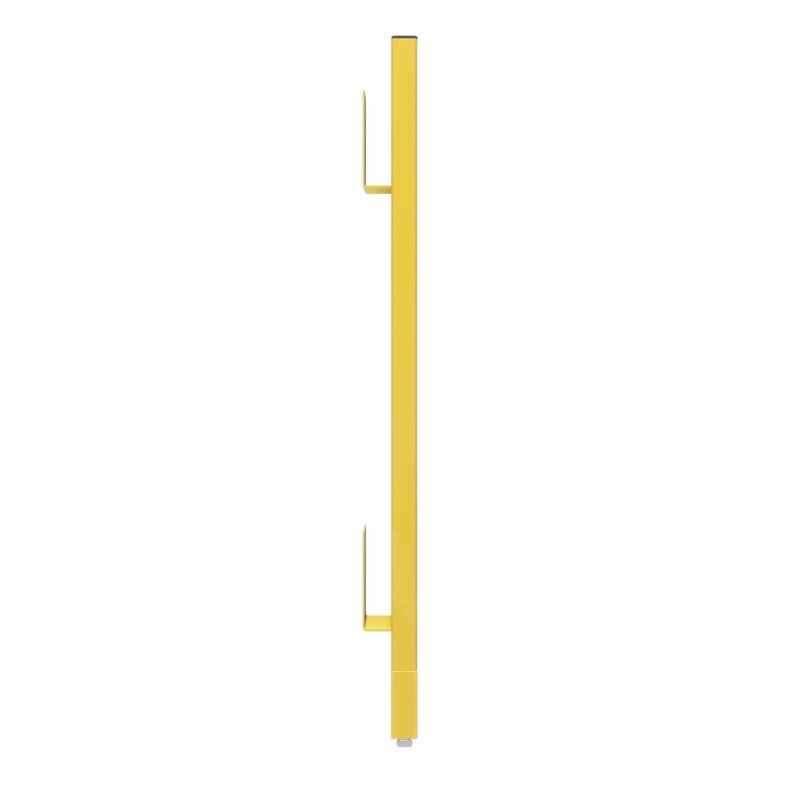
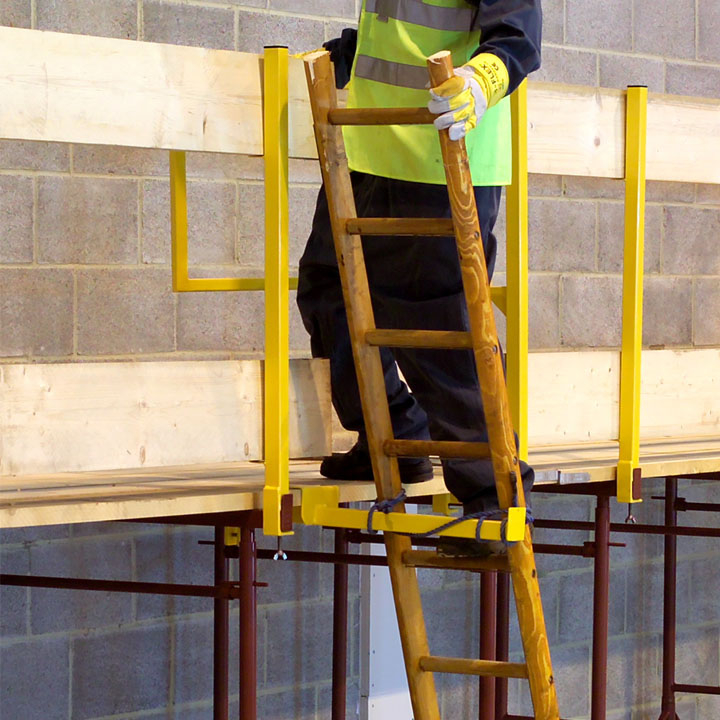
Trestle safety posts fix to the trestle and hold scaffold boards or timber planks as guardrails along the open sides and ends of the platform. Posts go on the trestles at every open edge, so a run that is boarded for its full length is guarded for its full length.
Trestle table gate
A trestle gate sits in the guardrail line and gives one controlled way on and off the platform. Once it is closed, the guarded edge is complete again, and nobody steps onto the deck at any other point.
Trestle ladder bracket
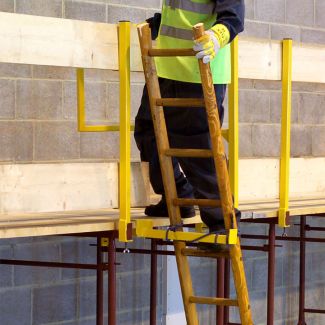
The trestle ladder bracket attaches to the trestle system and gives a ladder a fixed point at the platform, so the climb onto the deck is made from a secured ladder. Placing the bracket at the gate keeps access and entry at one point.
Trestle stabilisers
Trestle stabilisers are recommended wherever the trestles are used at a height of 1.2 m or more. They steady each trestle against sideways movement, which matters more as the trestle is extended and its height grows in relation to its base.
Trestle board S brackets
S brackets for trestle boards lock the ends of overlapping boards together where two lengths meet, so the joint cannot lift or slide apart under foot. They allow a run to be extended beyond the length of a single board while the deck stays continuous.
Setting out a trestle run
These checks are made each time a trestle run is set up, moved or adjusted.
- Stand every trestle on a firm, level base, and lay sole boards under the feet on soft ground, grass or loose fill.
- Never raise a trestle on bricks, blocks or packing, and never stack one trestle on another to gain height, because the next size up is the trestle for that job.
- Push the legs and locking pins fully home, and set every trestle in the run to the same height so the deck is level from end to end.
- Space the trestles to suit the span the boards are rated for, with each board bearing fully on the trestle heads.
- Overlap boards only over a trestle, never in the middle of a span, and hold each overlap with an S bracket.
- Confirm that the guardrails, gate and ladder bracket are in place before anyone works at height.
The risk assessment and method statement for the task can be posted at the point of access on RAMS boards, where the gang reads them before going onto the platform.
Popular Categories

Acrow Props
View Products >

Building Equipment
View Products >

Mortar Tubs and Mortar Bins
View Products >
Frequently Asked Questions
Why are builders trestles called band stands?
Band stand, or bandstand, is the trade's other name for the builders trestle, and both describe the same adjustable steel stand that carries scaffold boards. The name is common on site and in merchants' listings, and some suppliers sell the same product as steel trestles or scaffold trestles.
Do trestle platforms need guardrails?
Work at height on trestles falls under the Safety, Health and Welfare at Work (General Application) Regulations 2007, which require employers to take measures, so far as is reasonably practicable, to prevent a fall liable to cause personal injury. On a trestle platform those measures normally mean guardrails along the open sides and ends, with protected access onto the deck. The risk assessment for the task sets out which edges need guarding.
Are builders trestles a form of scaffolding?
A trestle platform is a temporary working platform, and it is often sold as scaffold trestles or trestle scaffolding because it uses the same scaffold boards. It is free-standing and built from trestles and boards, without the tubes, fittings and ties of an access scaffold, and it suits work at lower heights and over shorter runs.
What boards should go on builders trestles?
Builders trestles take timber scaffold boards, laid side by side across the trestle heads to form the deck. Each board is checked before use for splits, warping, rot and loose or missing end bands, and painted or heavily contaminated boards are kept off a working platform because they hide defects.
Who checks a trestle platform on a construction site?
On a construction site the Project Supervisor Construction Stage (PSCS), appointed under the Safety, Health and Welfare at Work (Construction) Regulations 2013, coordinates safety during the works, including work at height on trestles. The contractor whose team uses the platform is responsible for setting it up correctly, and a competent person checks it after it is erected or altered and before it is used.