







Geogrids
HERMEQ supplies geogrid for stabilising weak soils and strengthening the granular layers of roads, car parks, haul roads and working platforms on construction and civils projects. The range covers biaxial geogrids alongside Tensar TriAx and InterAx systems. Laid beneath the aggregate, the grid interlocks with the compacted stone, which confines the material, spreads the load from traffic over a wider area of subgrade and limits movement within the sub-base.
The result is higher bearing capacity, less rutting and settlement, and a firmer foundation on soft or variable ground.


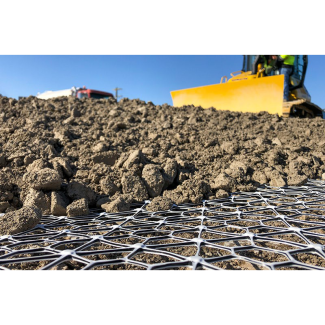
Biaxial, TriAx and InterAx geogrid mesh
Biaxial geogrid
Biaxial geogrid is an open polymer mesh with its strength along the roll and across it, graded by tensile strength from 20/20 to 40/40 kN/m. HERMEQ supplies standard biaxial geogrid rolls and Lotrak biaxial geogrid, both across that span of ratings. It is the grid to order when a specification calls for a biaxial grid by its kN/m rating and names no proprietary product, and it is the type most often laid under site haul roads, yards and capping layers.
Tensar TriAx geogrid
Tensar TriAx geogrid is a stabilisation grid with a triaxial aperture pattern, made in grades identified by a TX code. Engineers specify it for granular layers that have to stay stable under heavy, repeated trafficking, such as working platforms, haul roads and permanent pavement foundations. Tensar TriAx geogrid is the one to order when the drawing or specification names a TX grade.
Tensar InterAx geogrid
Tensar InterAx is the later generation of Tensar stabilisation grid, with grades identified by NX code and an HX grade in the same family. It is used for the long-term stabilisation of pavements, car parks and trafficked foundations, and for the temporary stabilisation of site roads and platforms. Tensar InterAx geogrid is the one to order when a design has been prepared with an NX or HX grade.

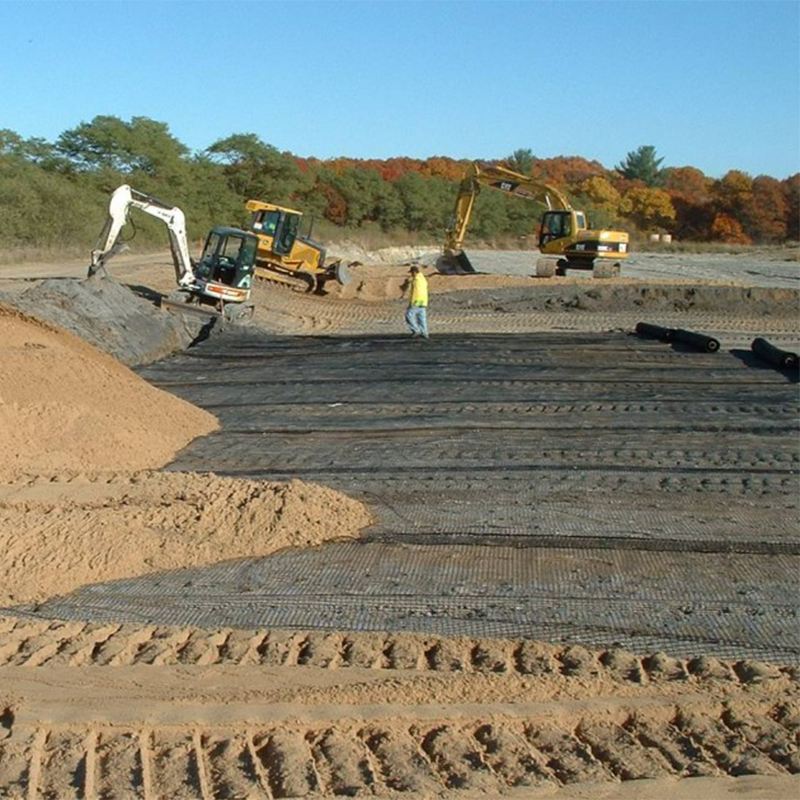
Triaxial geogrid vs biaxial
The decision turns on how traffic moves over the finished layer. A biaxial grid carries its strength in two directions, along the roll and across it, and suits loads that run mainly in one line, as on a straight haul road or access track. A triaxial grid has ribs running in more directions, so a wheel or track loads the grid in much the same way whichever way it travels, turns or brakes. That makes triaxial the stronger choice for turning heads, junctions, loading bays, yards where lorries reverse and manoeuvre, and platforms where tracked rigs slew. Where a haul road or platform has been designed, the drawing names the grid type and grade, and that choice is not swapped on site.
Geogrid for haul roads, car parks and working platforms
Haul roads and site access
Haul roads carry laden lorries, dumpers and excavators along the same wheel paths many times a day, often over subgrade that softens through a wet season. Heavier traffic and softer ground point to a higher biaxial rating or a TX grade, and a designed haul road will name the grade.
Car parks, yards and hardstandings
A car park or yard is permanent, and its traffic turns, parks and manoeuvres in every direction, so the grid usually sits in a designed pavement foundation under tarmac, concrete or block paving, with the grade set by that design. Geogrid works in the sub-base, which is a different job from the gravel grids that hold loose stone in place at the surface of a gravel car park.
Piling and crane platforms
Piling rigs and cranes put heavy, concentrated loads through their tracks and outrigger pads, and the platform under them has to carry those loads without local failure. The grid is part of a designed working platform, so the grade, the stone type and the platform thickness are fixed together by the temporary works design.
Railways, embankments and soft-soil capping
On rail work, biaxial grid reinforces capping layers and ballast. In embankments and capping over soft soil, the grid goes in at the base so that fill can be placed over ground that would otherwise be dug out and replaced. These are engineered works with the grade set by the designer, and the finished face of an embankment needs surface protection from rain and runoff, which is the job of erosion control products.
Geogrid and geotextile membrane
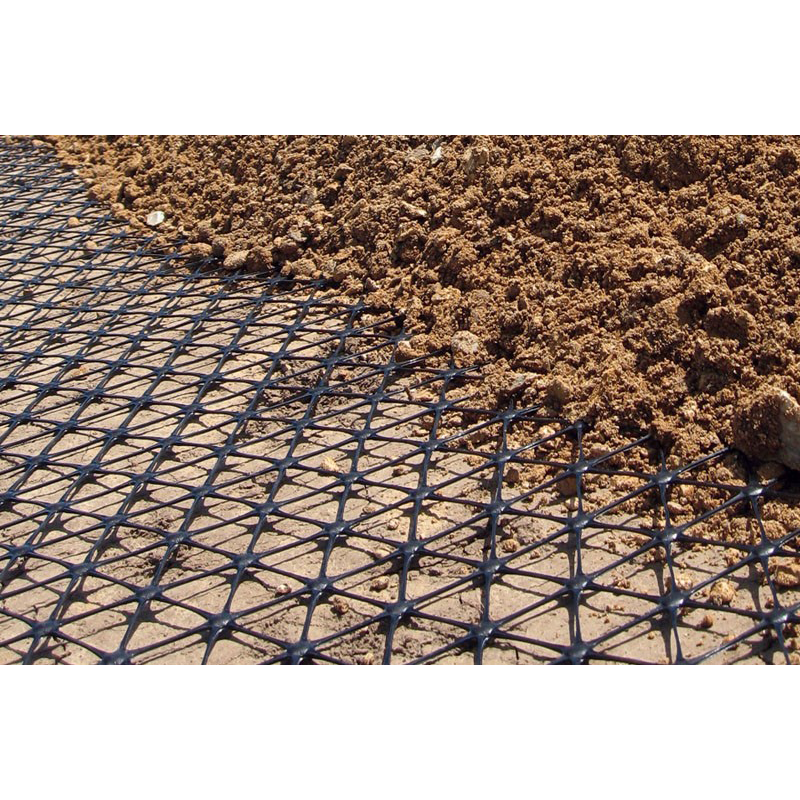
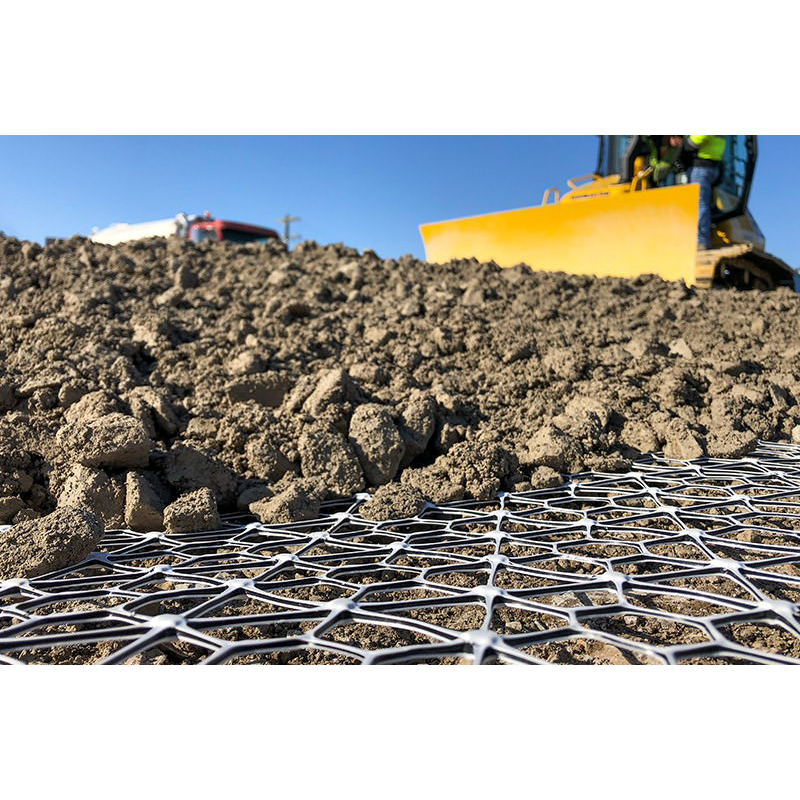
A geogrid and a geotextile do separate jobs. The grid interlocks with the stone and confines it, while a geotextile membrane separates the stone from the subgrade and lets water through without letting soil pass. On wet clay or silt, traffic pumps fines up into the sub-base until it loses strength, so the geotextile is laid on the formation first, the grid goes on top, and the stone is placed over both. Buyers asking for a geogrid membrane usually need both, the grid for strength and the geotextile beneath it for separation. Where water has to be carried out of the layer, the job belongs to geocomposite drainage.
Geogrid strength ratings and grades
The two families are graded in different ways, so a biaxial rating cannot be compared with a Tensar code like for like.
Biaxial kN/m ratings
A biaxial rating such as 30/30 gives the tensile strength of the grid in kN per metre of width, first along the roll and then across it. A higher rating suits heavier traffic and softer ground, and a lower rating suits lighter traffic on firmer ground.
Tensar grade codes
TX and NX codes identify a product, and the number in a code is not a strength that can be read against a kN/m rating. The grade is selected in the design for the ground, the traffic and the stone depth, so moving from one TX grade to another, or from a TX grade to an NX grade, changes that design. For either family, the grade on the order should match the grade on the drawing.
Popular Categories

Geotextile Membranes
View Products >

Grass Pavers & Gravel Grids
View Products >

Geomembranes & Pond Liners
View Products >
Frequently Asked Questions
Geogrid is an open mesh of polymer ribs joined at the junctions, made from plastics such as polypropylene, polyester or polyethylene depending on the manufacturer and the type. Stabilisation grids for granular layers are usually punched and stretched polymer sheet, which gives stiff ribs and fixed junctions that lock into compacted stone. Grids made for earth retention are often knitted or woven from polyester yarn.
The formation is trimmed, proof-rolled and cleared of soft spots and sharp debris, and any geotextile goes down first. The grid is rolled out flat in the direction the drawing shows, with adjacent rolls overlapped by the amount in the specification and pinned or weighted so they do not lift. Stone is tipped onto stone already placed and spread forward over the grid, plant does not run on bare grid, and the fill is compacted in layers.
Yes. On clay or soft ground, a biaxial grid laid under the sub-base stops the stone being pressed into the subgrade where cars turn and park, and a lower rating is usually enough for car traffic. A geotextile goes beneath the grid where the ground is wet clay or silt. The loose gravel on top is a separate layer from the sub-base the grid stabilises.
Grid for a reinforced retaining wall or reinforced slope is a structural element, specified by the wall or slope designer to suit the block system, the backfill and the height, and laid in layers into the fill as drawn. The geogrids in this range are for stabilising trafficked granular layers, so a wall or slope is built with the grid its designer names. The surface of a slope, where the aim is to hold soil and vegetation against rain and runoff, is covered by the erosion control range.
Measure the formation area, add the overlaps at roll edges and ends, and divide by the area of one roll, rounding up to whole rolls. Rolls across the range are 3.8 to 4 m wide and 50 to 75 m long, so the cover per roll depends on which grid is ordered. Curves, tapers and cuts around manholes add offcuts, so an irregular area needs a larger allowance than a straight run of constant width.