







Garden Fencing
Garden fencing from HERMEQ is a permanent way to mark out and separate spaces around a house, garden or outdoor area. Use it to secure the perimeter of a garden or to divide one plot into several usable spaces, from an open front garden to a private yard behind the house.
The range comes in metal and timber: bow top, ball top and estate railings for open frontages, feather edge closeboard with its posts, rails and gravel boards for solid boundaries, post and rail for paddocks and long rural runs, and square trellis panels for climbing plants. Ready-made garden fence panels, such as pressure treated larch lap panels, are in the timber fence panels range.


Types of garden fencing and railings
The three railing styles share one finish, galvanised and then powder coated black for two layers of protection against corrosion, so the choice between them rests on the top and the setting. Bow top and ball top come at 1.0 m or 1.2 m high, and the timber types are chosen by how much of a screen the boundary needs.
Bow top railings
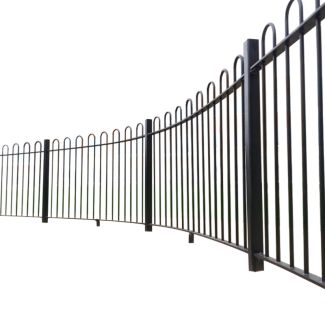
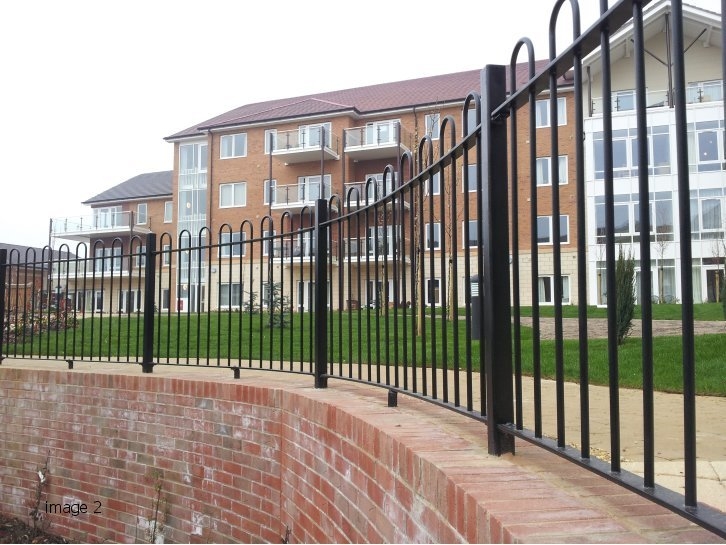
Bow top railings, also called hoop top railings, finish the uprights in rounded loops, so the top of the run has no points or finials. They are the usual choice beside footpaths, play areas and front gardens where children and pets are about.
Ball top railings
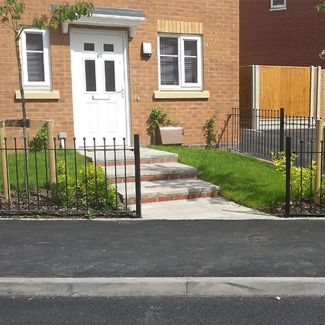
Ball top railings cap each upright with a round finial, which gives a neater and more formal line than a hoop. They have become a popular choice on new build housing, and they suit a low front boundary that should frame the house without hiding it.
Estate railings
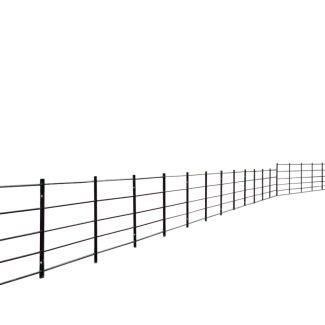
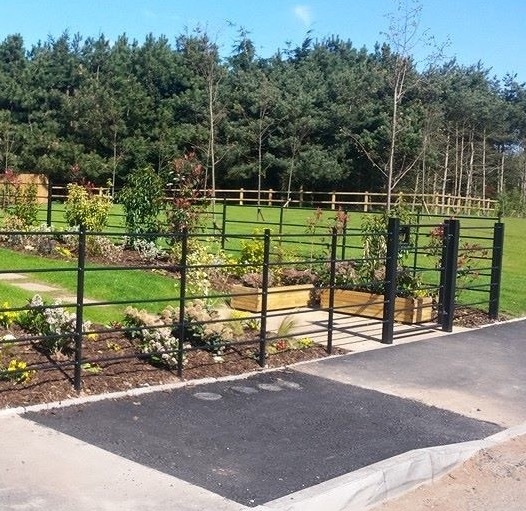
Estate railings, known in the trade as estate fencing or parkland railings, are the open railing long used around country houses, lawns and drives, and they are now popular on new build housing projects as well. Choose them for a long boundary that should still read as open ground, such as a lawn edge, the line of a drive or a garden beside a field.
Feather edge fencing
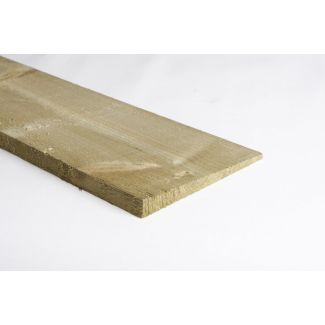
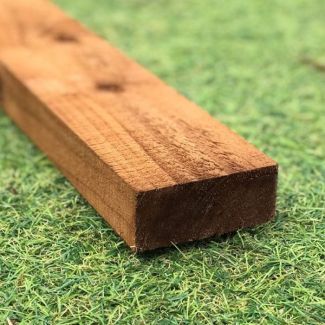
Feather edge boards are tapered across their width and fixed vertically, each one overlapping the next, so the finished fence, usually called closeboard, is a solid screen with no gaps to see through. It gives a solid timber screen for private rear gardens and boundaries between neighbours. Because it is built board by board on site, closeboard runs to any length and can be stepped down a slope, and the feather edge fencing boards are made to pair with the notched posts and arris rails described below.
Post and rail fencing
Post and rail is an open timber fence of upright posts carrying horizontal rails, used for paddocks, field edges, drives and long rural boundaries where the line needs marking more than screening. The post and rail timber rails in the range are made for agricultural fencing of this kind. Where livestock or dogs have to be kept in, the rails are commonly backed with wire from the wire and chain link fencing range.
Garden trellis panels
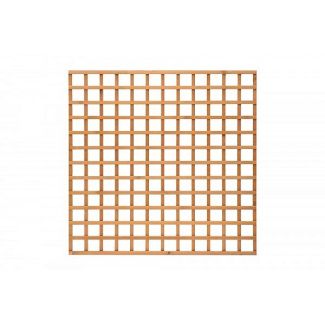
Trellis is open timber lattice for climbing plants such as ivy, used to dress a bare wall, divide a patio from a lawn or add light screening and height along a fence line. The square garden trellis panels suit domestic and commercial settings, and the choice of widths lets a run of mixed panels be laid out to fit the space between posts or along a wall.

Metal railings or wooden garden fencing
Railings suit a boundary that should mark the edge of a property and keep it in view, and timber suits one that has to screen it. An open railing lets light and the view from the street pass through, which is why front gardens, frontages facing a road and plots where the house is meant to be seen are usually railed, and because the finish is applied before delivery a railing needs no painting on site. A closeboard timber fence gives privacy and a solid screen behind the house, against a neighbour's garden, a lane or a car park.
The two behave differently in wind. Gusts pass through an open railing, while a solid timber fence takes the full force across its face, so on an exposed plot the post setting decides how well a closeboard fence stands. Upkeep differs as well: a railing needs only an occasional wash and a touch up wherever the coating has been scratched through, while pressure treated timber lasts longer with a wood preservative or stain every few years and with soil, compost and plants kept clear of the boards.
A depot, school or commercial site that needs a security perimeter is a different job, and it is served by V mesh perimeter fencing and the rest of the permanent fencing range.
Feather edge fence posts, rails and gravel boards
Each timber fence has its own post and rail pair, and the two pairs are easily confused when ordering.
Notched posts and arris rails
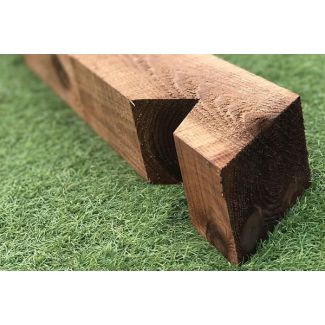
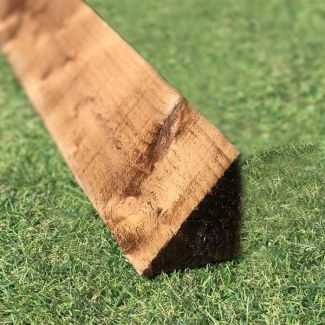
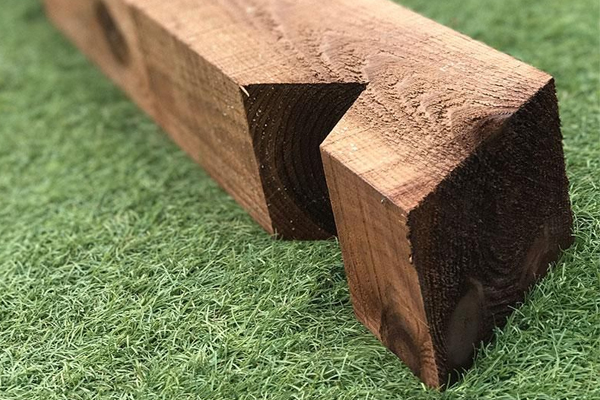
Feather edge is built on notched timber posts, which have slots cut through them to take the ends of the rails. The arris rails are triangular in section, so one flat face sits upright to receive the boards, which are nailed to the rails with each board overlapping the last. Two rails are usual on a low fence and three on a full height one, and the posts come in a choice of section sizes and lengths to suit the height and exposure of the run.
Gravel boards
Gravel boards run along the foot of the fence between the posts and keep the feather edge boards clear of the soil. The gravel board takes the wet and the splash from the ground, so the boards above stay dry and free of rot, and a worn gravel board can be replaced on its own without taking the fence apart.
Square timber posts and timber rails
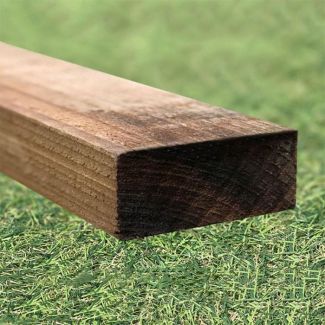
Post and rail uses plain square posts with the rails fixed across their face, and the joints are staggered from one rail to the next so no single post carries every joint. The pressure treated timber posts are made for post and rail lines at domestic, commercial and industrial grade. A notched post is cut for arris rails and a plain post has no slot for one, so match the post to the fence before ordering.
Garden fencing on new build housing and estates
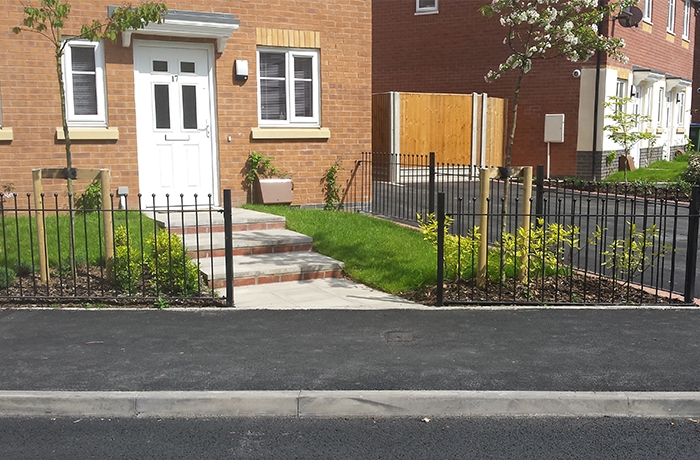
On a housing development the boundary usually changes with its position on the plot, and each position brings its own demands.
Front plots and open frontages
Front boundaries on a development are usually low railings, and what matters is consistency along the street: one style, one height and one finish on every plot, with gate openings lined up to the paths and an end post at each plot line so one plot can be repaired without disturbing the next. Estate fencing for larger developments is listed under domestic fencing and railings.
Rear garden boundaries between plots
Between back gardens, feather edge closeboard gives each household a private garden. The side the boards face is decided at setting out, since the posts and rails show on the other side, and the gravel boards are best set to the finished ground level, which often rises once topsoil goes down and the gardens are landscaped.
Measuring a garden fence run
Height comes first because it settles the type of fence, and the run and the ground then settle the quantities.
Fence height
The lower railing height marks the edge of a lawn or frontage, and the taller one suits a front garden where children or a dog need to be kept in while the house stays in view. Behind the house, privacy calls for full height closeboard at around head height, set out so the top runs level or steps evenly down a slope.
Run length, bays and end posts
Railings come as pre-made bays joined with the fixings supplied, so a run is counted in bays, with an end post wherever the run stops and a gate at each opening, and the railing product pages carry calculators that work this out from a measured length. Timber fencing is counted in components: posts at each bay, rails to suit the height, boards to fill the length and a gravel board along the foot. An opening for cars needs a wider gate from driveway and vehicle access gates.
Ground and post fixing
Garden fence posts are normally set in concrete or postcrete, in holes deep enough to hold the fence against wind, with the top of the concrete finished just above ground and sloped so water runs off the timber. Any timber post set in the ground needs treatment for ground contact, which is the UC4 class the square posts are treated to.
Popular Categories

V Mesh Fencing
View Products >

Palisade Fencing
View Products >

Estate Fencing & Railings
View Products >
Frequently Asked Questions
Under the Planning and Development Regulations 2001, a wooden fence or railing within or bounding the curtilage of a house is generally exempted development if it is no higher than 2 m, or 1.2 m in front of the building line. Both railing heights in this range fall within the front garden limit. The exemption does not cover a metal palisade or other security fence, and a planning condition on a housing estate or the protected structure status of a house can remove it, so the local authority planning section is the place to confirm before work starts.
Railings are priced per bay, so the cost of a run follows the number of bays plus the end posts and any gates. Timber fencing is priced per component, with posts, rails, boards and gravel boards bought separately, so the total depends on the length, the height and the number of rails. The price of each item is on its product page.
For marking a long boundary, post and rail is usually the cheapest timber fence per metre, because it uses far less timber than a solid fence. Where a solid screen is needed, feather edge closeboard is the usual economical choice, since each post, rail and board is bought only in the quantity the run needs.
Yes. The ball top railings can be ordered with matching gates, end posts and postcrete, so the entrance and its fixings arrive with the run.
Yes, a trellis panel fixed above closeboard adds height and a lighter top while the solid part of the fence stays at its own height. The narrower square trellis panels suit this, laid along the top of the fence and fixed to posts tall enough to carry them. The combined height of fence and trellis counts towards the planning height limit for a boundary.
Both are pressure treated timber, and the colour comes from the preservative used. Green treated timber weathers towards a silver grey over time, while brown treated timber keeps a darker, warmer tone closer to a stained fence. The feather edge boards and the timber posts both come in green and brown, so boards and posts can be matched along a run.